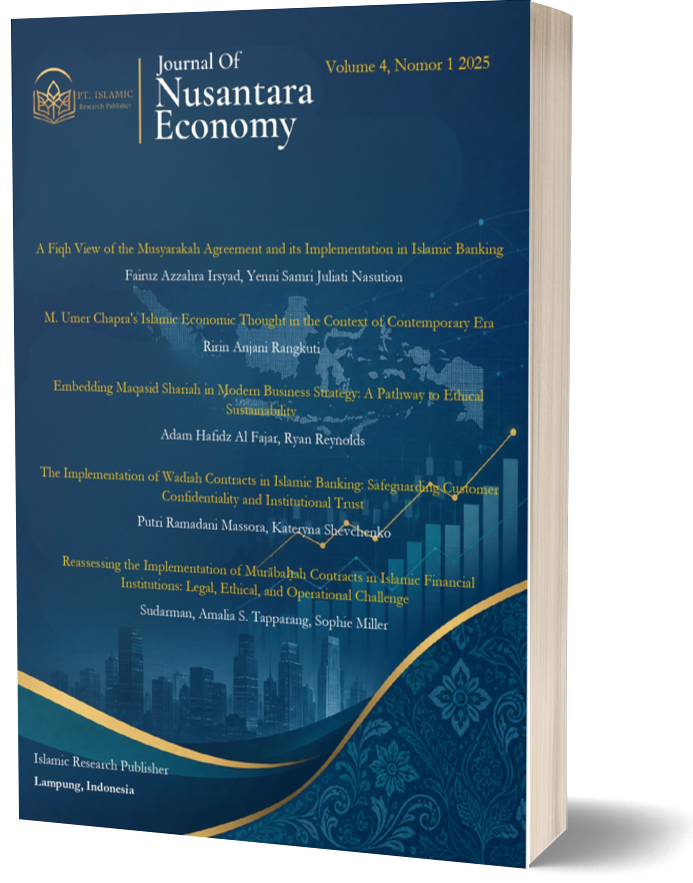
Reassessing the Implementation of Murābaḥah Contracts in Islamic Financial Institutions: Legal, Ethical, and Operational Challenge
DOI:
https://doi.org/10.66325/nusantaraeconomy.v3i2.185Keywords:
Murābaḥah Contract; Islamic Banking; Maqāṣid Al-Sharī‘Ah; Sharia Compliance; Islamic Finance Reform.Abstract
Murābaḥah contracts constitute one of the most widely used financing instruments in Islamic financial institutions and are designed to provide a Sharia-compliant alternative to conventional credit-based transactions. Despite their dominance in Islamic banking practices, growing concerns have emerged regarding their legal compliance, ethical implications, and operational efficiency. This study aims to reassess the implementation of murābaḥah contracts by critically examining their legal, ethical, and operational challenges and by exploring strategies for reform that align these contracts with the objectives of Islamic law (Maqāṣid al-Sharī‘ah). The research adopts a qualitative research design employing a mixed qualitative approach that integrates systematic literature review, case studies from Islamic financial institutions across different regions, and semi-structured interviews with Islamic finance experts, practitioners, and regulators. Data were analyzed using thematic analysis and comparative analysis to identify recurring patterns and discrepancies in murābaḥah implementation across institutional contexts. The findings reveal three major challenges. First, legal challenges arise from inconsistencies in Sharia compliance and regulatory ambiguities, particularly concerning ownership transfer, agency arrangements, and the continued reliance on interest-based benchmarks for determining profit margins. Second, ethical challenges are reflected in the partial realization of Maqāṣid al-Sharī‘ah, where murābaḥah financing often prioritizes consumptive lending rather than promoting justice, social welfare, and productive economic development. Third, operational challenges include complex documentation procedures, high transaction costs, and institutional overdependence on murābaḥah financing, commonly described as the “murābaḥah syndrome.” The study further identifies the need for comprehensive reforms, including the reformulation of murābaḥah products, diversification toward partnership-based financing models, strengthening of regulatory frameworks, and the integration of financial technologies to improve transparency and compliance. This study contributes to the literature on Islamic finance by offering a holistic framework for reassessing murābaḥah practices and by proposing practical strategies to enhance their alignment with Islamic ethical principles and sustainable economic development.
Downloads
References
Adiwarman A. Karim. (2001). Ekonomi Islam: Suatu Kajian Kontemporer. Gema Insani.
Aladin Koto. (2011). Ilmu Fiqih dan Ushul Fiqh. PT Raja Grafindo Persada.
Basri, J., Dewi, A. K., & Iswahyudi, G. (2022). Pembiayaan murabahah pada perbankan syariah dalam perspektif hukum di indonesia. AL-MANHAJ: Jurnal Hukum Dan Pranata Sosial Islam, 4(2), 375–380.
Hendi Suhendi. (2005). Fiqh Muamalah Edisi Pertama. PT RajaGrafindo Persada.
Ikbal, M., & Chaliddin, C. (2022). Akad Murabahah Dalam Islam. Al-Hiwalah: Journal of Sharia Economic Law, 1(2), 143–156.
Ikit. (2018). Manajemen Dana Bank Syariah. Gava Media.
Izza, M. (2023). Membumikan Ayat dan Hadis dalam Perekonomian. Penerbit NEM.
Jaih Mubarok dan Hasanuddin. (2018). Fikih Mu’amalah Maliyyah Akad Jual Beli. Simbiosa Rekatama Media.
Jamaluddin, J. (2017). Konsep dasar muamalah & etika jual beli (al-ba’i) perspektif islam. Tribakti: Jurnal Pemikiran Keislaman, 28(2), 289–316.
Kamal, J. (2022). Problematika pada perbankan syari’ah (kontrak pembiayaan murabahah). Jurnal An-Nahl, 9(1), 18–27.
Kementrian Agama RI. (2002). Al-Qur’an dan Terjemahnya. CV Darus Sunnah.
Lathif, A. A. (2013). Konsep dan aplikasi akad murabahah pada perbankan syariah di Indonesia. AHKAM: Jurnal Ilmu Syariah, 12(2).
Lubis, A. (2016). Aplikasi Murabahah Dalam Perbankan Syariah. FITRAH: Jurnal Kajian Ilmu-Ilmu Keislaman, 2(2), 181–202.
Maulistina, L. (2017). Strategi Penyelesaian Pembiayaan Bermasalah Terhadap Akad Murabahah Dalam Perspektif Ekonomi Islam (Studi pada Bank Pembiayaan Rakyat Syariah Bandar Lampung. UIN Raden Intan Lampung.
Mauluddin, M. S. (2018). Pembiayaan Murabahah Dalam Perspektif Fatwa DSN MUI. Qawãnïn Journal of Economic Syaria Law, 2(1), 1–19.
Nasution, S. F. (2021). Pembiayaan murabahah pada perbankan syariah di indonesia. AT-TAWASSUTH: Jurnal Ekonomi Islam, 6(1), 132–152.
Prabowo, B. A. (2009). Konsep akad murabahah pada perbankan syariah (Analisa kritis terhadap aplikasi konsep akad murabahah di Indonesia dan Malaysia). Jurnal Hukum Ius Quia Iustum, 16(1), 106–126.
Prayoga, M. R., & Firdaus, R. (2024). Tantangan dalam Implementasi Akad Murabahah di Perbankan Syariah. Jurnal Intelek Dan Cendikiawan Nusantara, 1(6), 9433–9442.
Putri, R., & Yanti, F. (2023). Implementasi Akad Murabahah Dan Permasalahannya Dalam Perbankan Syariah. Mu’amalat: Jurnal Kajian Hukum Ekonomi Syariah, 15(2), 189–196.
Sayyid Quthb. (2018). Tafsir Ayat-Ayat Riba: Mengupas Persoalan Riba Sampai Ke Akar- Akarnya Terj. Ali Rohmat. Wali Pustaka.
Sugiyono. (2022). Metode Penelitian Kuantitatif, Kualitatif dan R&D. Alfabeta.
Syaifullah, S. (2014). Etika Jual Beli Dalam Islam. HUNAFA: Jurnal Studia Islamika, 11(2), 371–387.
Veithzal Rivai dan Andria Permata Veithzal. (2008). Islamic Financial Management: Teori, Konsep dan Aplikasi: Panduan Praktis Untuk Lembaga Keuangan, Nasabah, Praktisi dan Mahasiswa Edisi I. RajaGrafindo Persada.
Wiroso. (2005). Jual Beli Murabahah. UII Press.
Yunita, A. (2018). Problematika Penyertaan Akad Wakalah dalam Pembiayaan Murabahah pada Bank Syariah. Varia Justicia, 14(1), 21–29.
Yusuf, A. M. (2016). Metode penelitian kuantitatif, kualitatif & penelitian gabungan. Prenada Media.
Downloads
Published
Issue
Section
License
Copyright (c) 2024 Sudarman, Amalia S. Tapparang, Sophie Miller

This work is licensed under a Creative Commons Attribution-ShareAlike 4.0 International License.